It’s been a while since I’ve done an NBA analytics project, but I’ve recently been intrigued by interactions between players within teams. Oftentimes, fans have a hunch that two players “mesh” well together or two players’ playstyles do not complement one another. However, for the most part, this is a qualitative observation. In this article, I will present a simple, quantitative way of discovering favorable/unfavorable duos in the NBA (in addition to investigating specific duos).
Simple concepts
The concepts discussed in this article come from biology. Specifically, in ecology, the term symbiosis refers to the relationship between two different species. These relationships can take many forms:
- Mutualism - both species benefit
- Parasitism - one species benefits, the other species is harmed
- Commensalism - one species benefits, the other species is neither harmed nor benefitted
- Neutralism - neither species is affected
- Competition - both species are negatively affected

Graphic from ProProfs
When talking about basketball, we are no longer talking about biological species but rather interactions between two players in a lineup. For instance, a mutualistic relationship would be a relationship in which having two players in a lineup is more efficient than having either one without the other. If we are appropriately able to single out such mutualistic relationships (and discover which players do not mesh well together i.e., those with a competitive relationship), this is a useful tool for coaches when building lineups.
Quantifying Symbiosis
In order to quantify the relationships between players, I follow a very simple process. Let us assume that we are attempting to quantify the symbiotic relationship between player A and player B on a given team X. We will sort lineups for team X into four categories:
- lineups with player A but not player B,
- lineups with player B but not player A,
- lineups with both player A and player B, and
- lineups with neither player A or player B.
We can then calculate net rating for categories 1, 2, and 3. If the net rating of category 3 is greater than the net rating of categories 1 and 2, I label it a mutualistic relationship (a favorable duo to play together). This process gives us a simple, descriptive indication of how duos perform together, not an isolated measure of how one player affects another. If the replacement player in a lineup for a given player B is significantly worse than player B, this would exaggerate the apparent benefit of adding player B to a lineup with player A.
There is also the issue of multicollinearity. Since a lineup consists of five players, it is impossible to control fully for context, and other players may affect these numbers. Opponent quality, roles, and substitution patterns can also influence the lineup ratings.
Distribution of Duos
We begin our analysis by calculating values for every given duo in the NBA (such that they have played at least 400 minutes together and 400 minutes apart). This leaves us with 672 duos in the league.
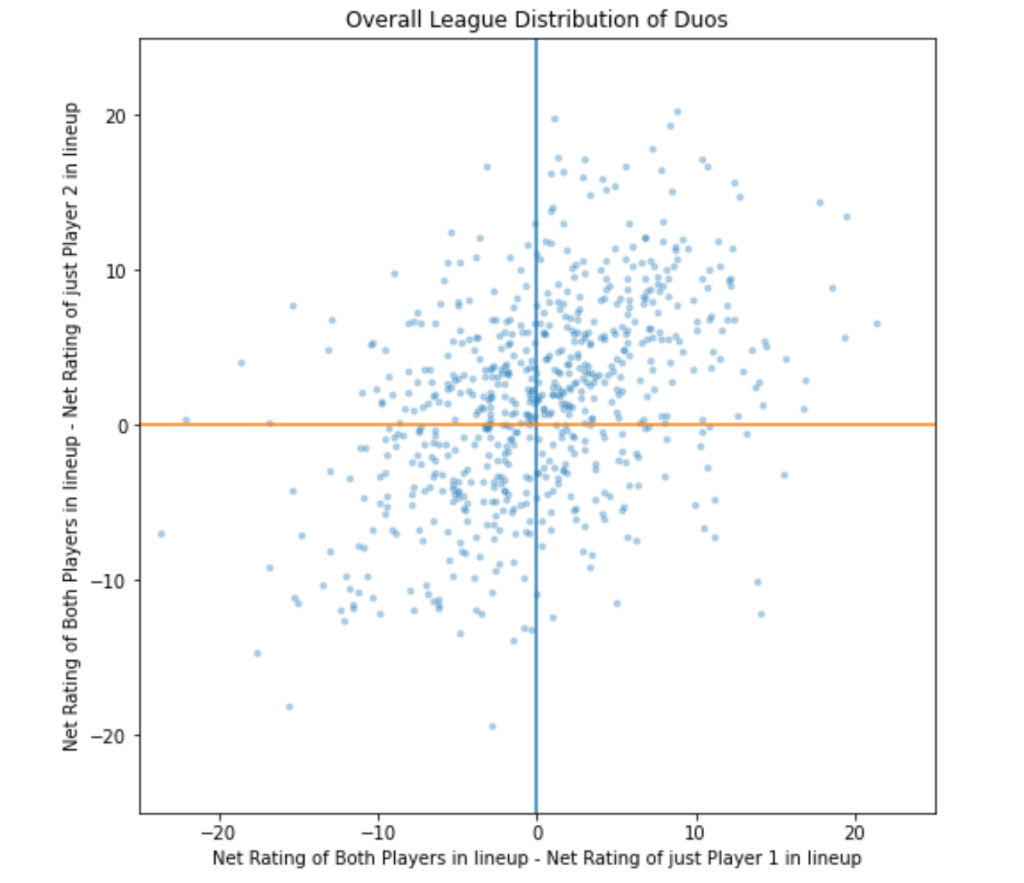
In the above graph, we first note that the upper right corner is mutualistic duos, while the bottom left is competitive duos (duos that do not play well together). The other two quadrants represent duos where one player is positively affected while the other player is negatively affected.
The first thing that I found interesting was the correlation between the two variables in the plot (Spearman correlation was 0.44). This shows a moderate monotonic relationship between our two variables: when adding player B to lineups with player A is associated with a lower net rating, adding player A to lineups with player B also tends to be associated with a lower net rating.
Interactions within Teams
Phoenix Suns
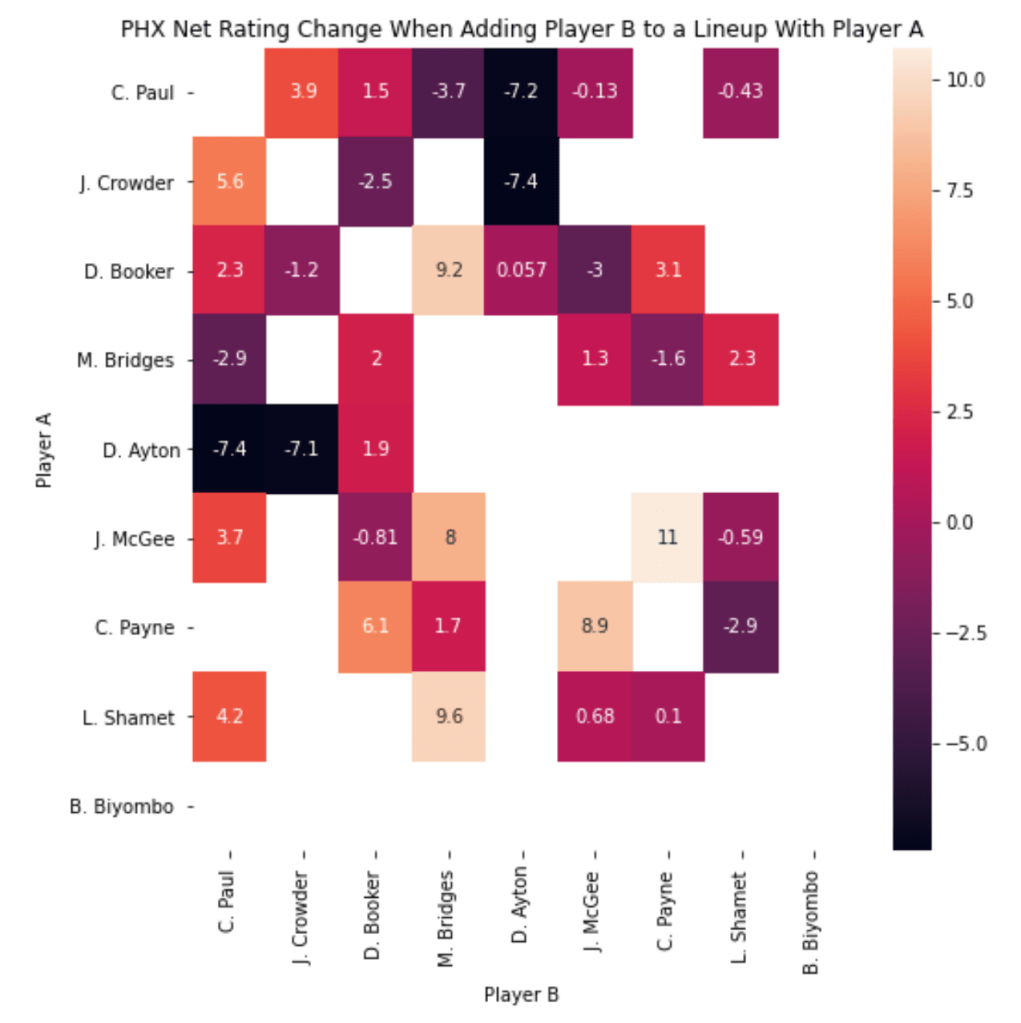
In this graph, each box represents the net rating change when adding Player B to a Lineup with player A (a white box represents a duo which we do not have enough minutes of). To understand what this means, we will ask a question: How do lineups with Chris Paul and DeAndre Ayton compare to lineups with just Chris Paul (and not DeAndre Ayton)?
With the phrasing of this question, player A is Chris Paul and player B is DeAndre Ayton. The value is then -7.2. What does this mean? A Suns lineup with Chris Paul and not DeAndre Ayton is more favorable than a lineup with both Chris Paul and DeAndre Ayton by approximately 7.2 points per 100 possessions. Similarly, if we look at lineups with just DeAndre Ayton and not Chris Paul (player A is DeAndre Ayton now), the value is -7.4: again unfavorable.
By this descriptive measure, the relationship between Chris Paul and DeAndre Ayton appears competitive. This result seemed somewhat counterintuitive to me, but it does not isolate the effect of either player from their lineup context.
Thus, I decided to delve a bit deeper. Based on data from PBP Stats, lineups with both Chris Paul and DeAndre Ayton have a net rating of 6.93 on average. However, when on lineups separately, Paul and Ayton’s lineups have net ratings of 13.27 and 12.46, respectively.
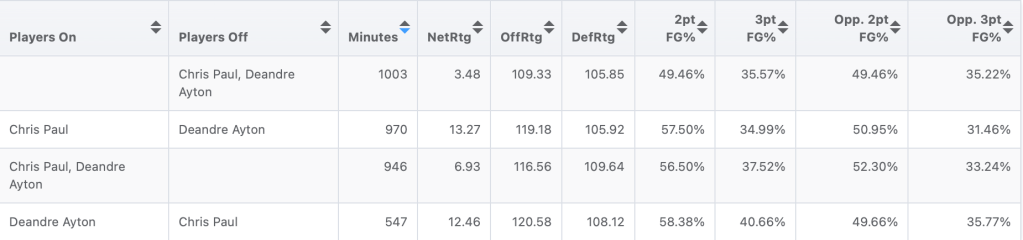
This could very well be an artifact, but it still remains an interesting result to investigate further.
Among the more intuitive results from the graph, adding Chris Paul is associated with a higher net rating for most lineups. Devin Booker/DeAndre Ayton and Devin Booker/Chris Paul also have positive relationships by this measure.
Los Angeles Lakers
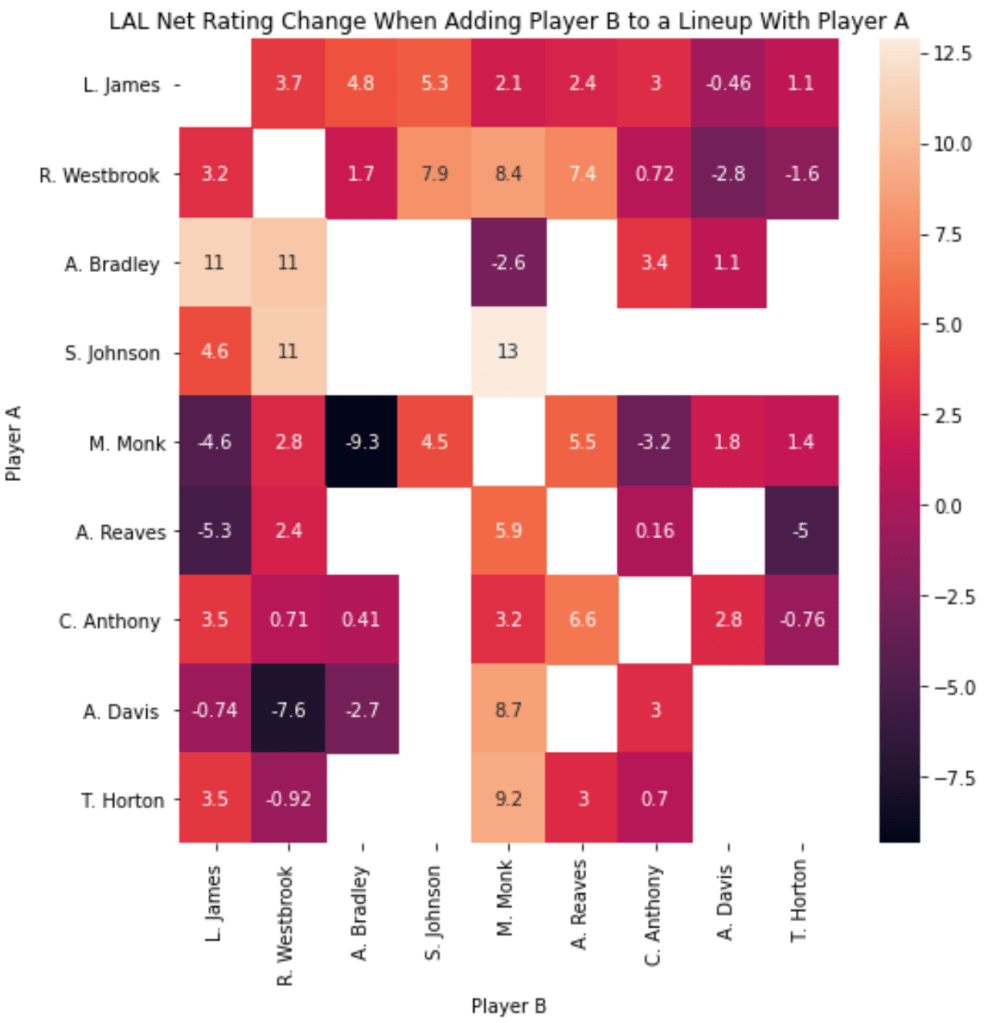
In our graph, Malik Monk and Austin Reaves have a strongly positive lineup-rating relationship by this measure. This is a relationship that caught the eye of the Lakers coaching staff/front office and was a duo that was used in a big win against the Warriors.
Outside of this duo, Malik Monk/Avery Bradley and Anthony Davis/Russell Westbrook have negative relationships by this measure, while Avery Bradley/LeBron James have a positive one.
Golden State Warriors
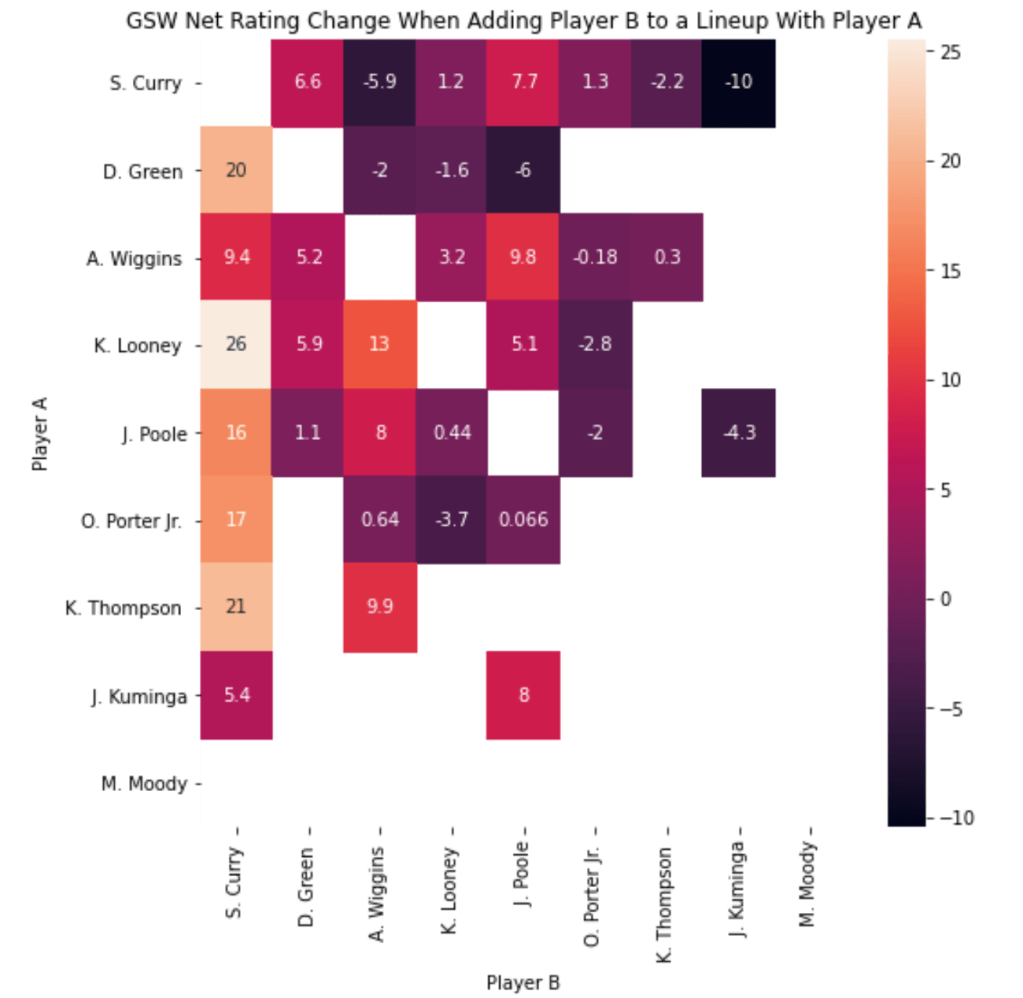
For Golden State, Steph/Draymond and Steph/Poole have positive relationships by this measure. Adding Steph to Klay lineups is associated with a higher net rating, while adding Klay to Steph lineups is not.
Minnesota Timberwolves
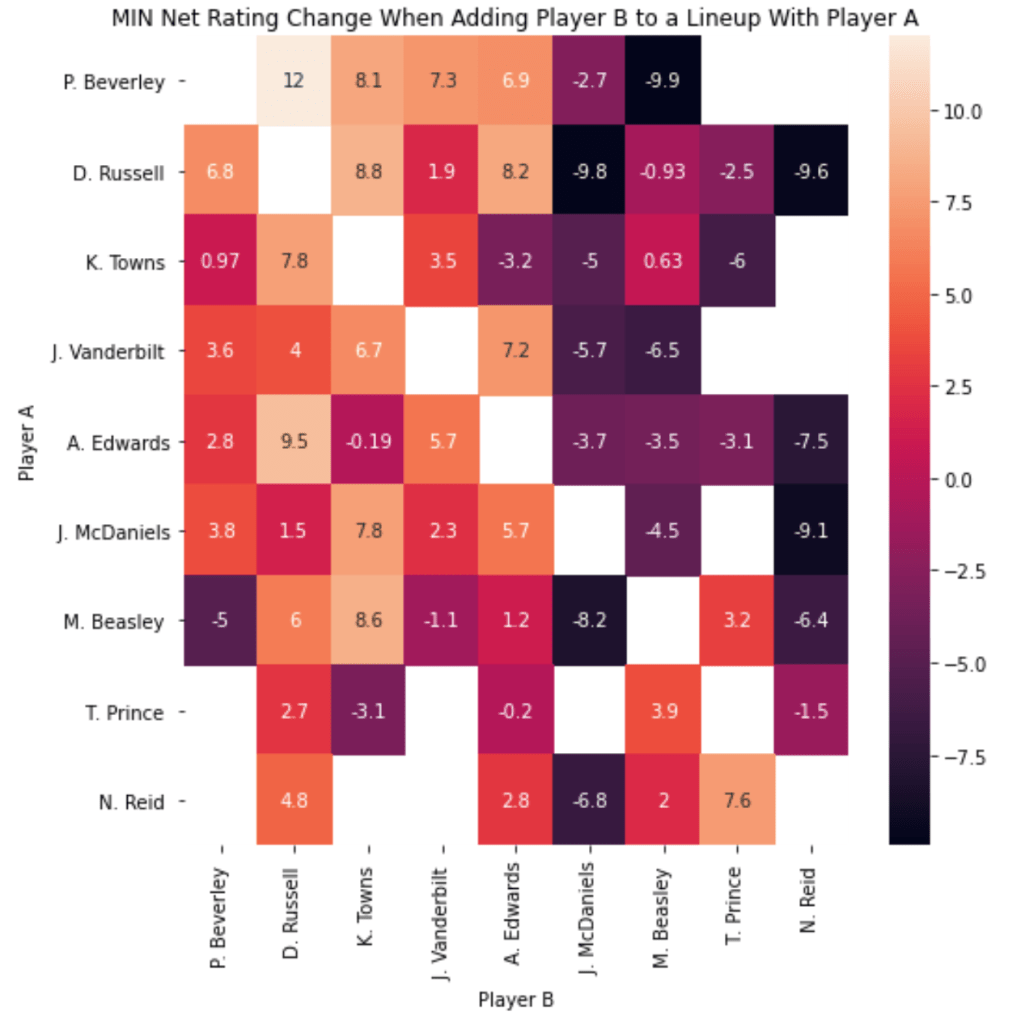
The last team we’ll look at is one of the hottest teams in the league right now. KAT/D’Angelo, Anthony Edwards/D’Angelo, and Pat Bev/D’Angelo all have positive relationships by this measure.
Conclusion
I think this is a useful preliminary way to describe how lineups perform with different player combinations. It does not isolate the effectiveness of a duo from the other players, opponents, roles, and substitution patterns involved, but it can highlight combinations worth investigating further.