I used archived 2015-16 SportVU player-tracking data to look at where on the court assists come from. Along with league-wide trends, I looked at assists off misses and compared guards, forwards, centers, and individual players.
Why?
I found this problem interesting because of its potential implications.
Players in the NBA—and basketball more broadly—have inherent biases toward where they prefer to shoot. For instance, if a player like Ben Simmons were standing at the three-point line, you wouldn’t guard him as tightly as you would Stephen Curry. Analysis of the specific locations from which players prefer to pass and shoot could help players anticipate what might happen next in a possession and improve defensive strategy.
Methods
SportVU data captures every player on the court, along with the ball, about 25 times per second. I cross-referenced this data with NBA play-by-play data to determine a general timeframe for each assist.
I then determined the exact time of the shot release by smoothing the ball-height data and taking its derivative with respect to time. From there, I backtracked to find the final pass before the shot and recorded the locations of both the passer and shooter. I processed the data with pandas and Python, then used a kernel density estimator from Seaborn to generate the heat maps.
The visualization is heavily based on Savvas Tjortjoglou’s guide to visualizing NBA shot charts.
This method found around twice as many assists as my original approach, changing the overall distribution. However, not all games from the 2015-16 season were in my dataset, and I was still unable to extract every assist from the available logs. For that reason, I mainly trust the league-wide and position-specific graphs rather than drawing firm conclusions about individual players.
Passes by Shooter Location
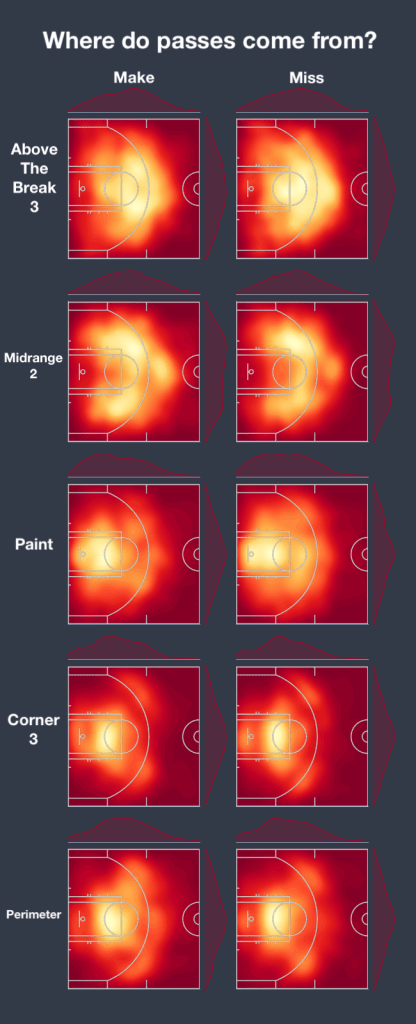
The grid is organized by shooter location and whether the shot was made or missed. The distribution of assists for misses is quite similar to that of makes.
The corner-three kick-out assist is widely used across the league. In this example, Cody Martin drives into the paint, attracts three defenders, and leaves PJ Washington open in the corner.
Splitting Up by Position
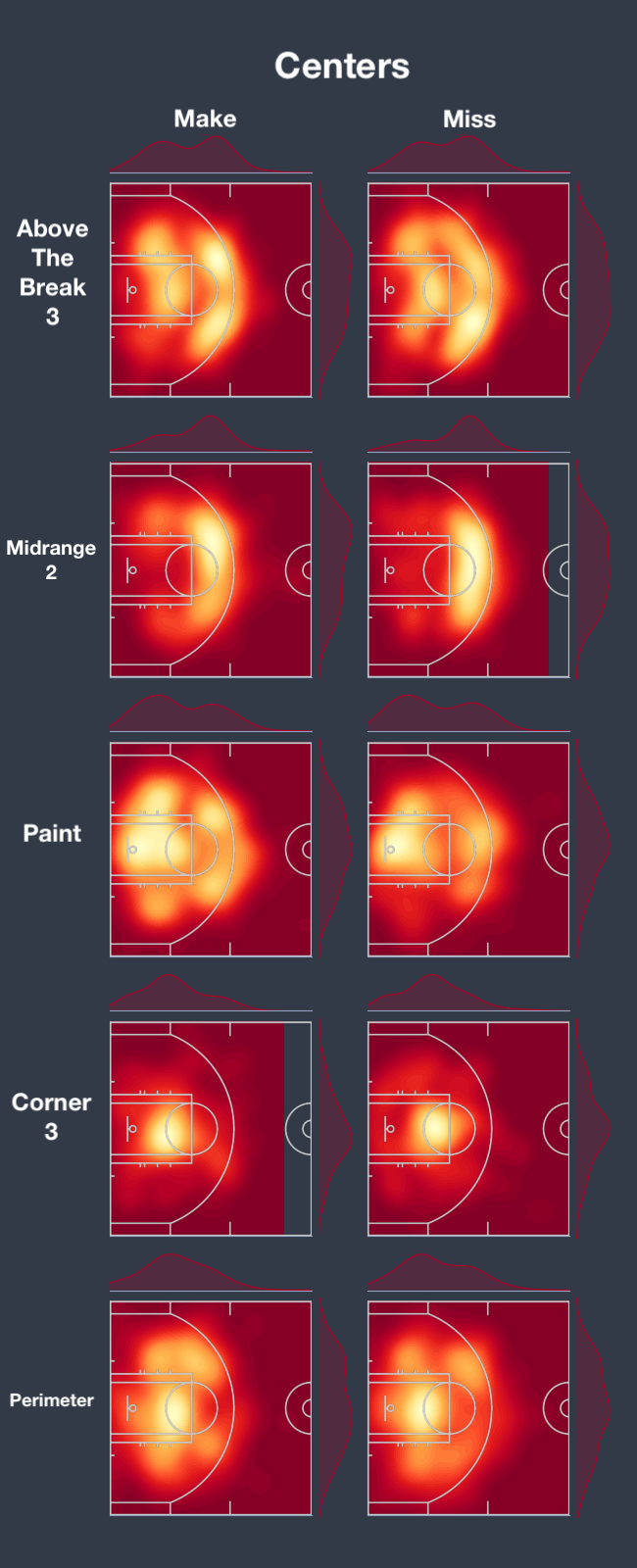
Centers
Forwards
Guards
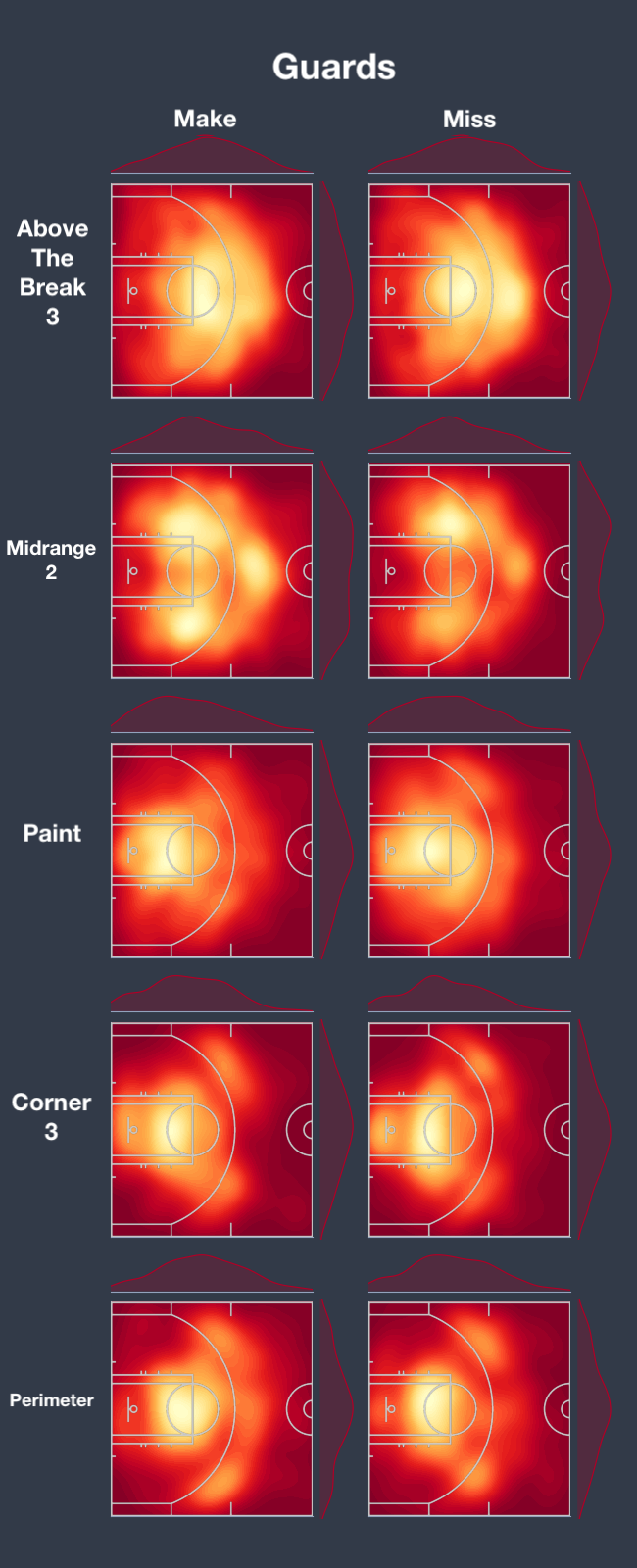
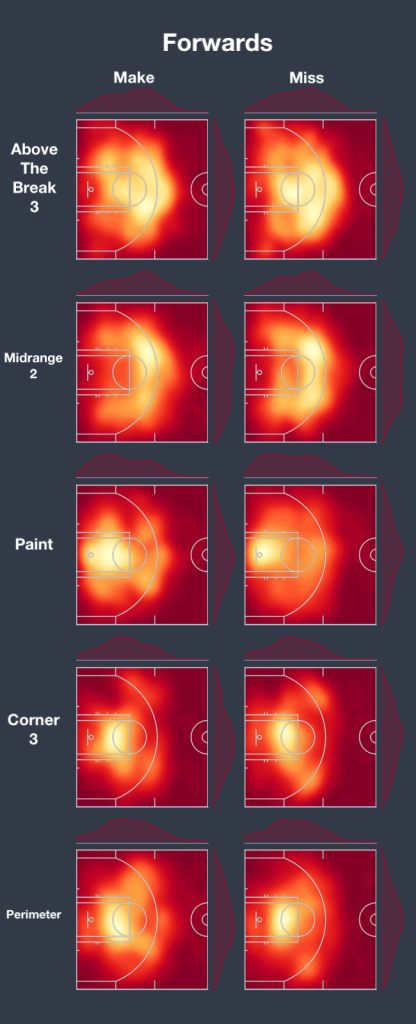
Guards generally make assists farther from the hoop than forwards and centers, which is expected based on offensive positioning. However, guards also pass more often from behind the three-point line than forwards.
This Jamal Murray assist is a good example of an action that guards perform more often than forwards on above-the-break threes. Murray gets double-teamed as Nikola Jokic sets a screen, then makes a pass from behind the three-point line. Will Barton fakes out Willie Cauley-Stein and gets an open look from three.
The next play highlights a slightly different tendency among forwards. Jalen McDaniels cuts toward the top of the key, attracts two Miami defenders, and creates an open above-the-break three for Caleb Martin.
Individual Players
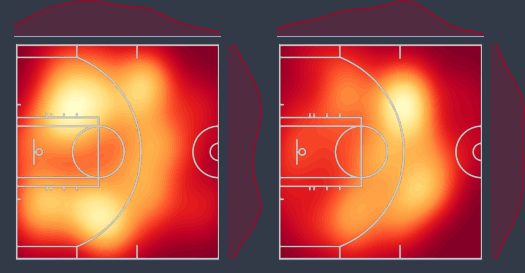
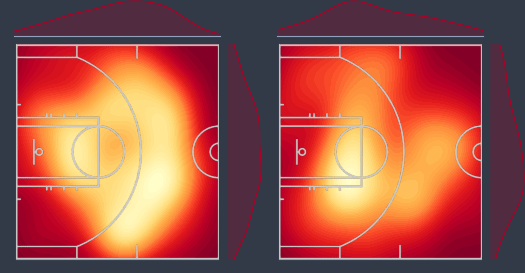
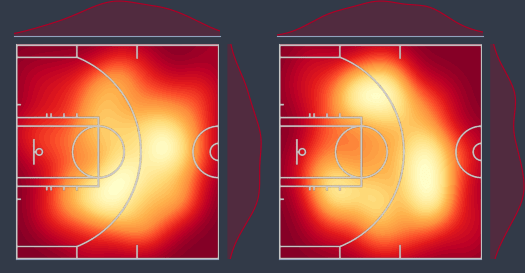
The players below each have more than 80 mapped assists for both made and missed shots. Although this is more data than I had initially, we still need larger samples to make firm conclusions about individual players.
Ricky Rubio
Stephen Curry
Chris Paul
LeBron James
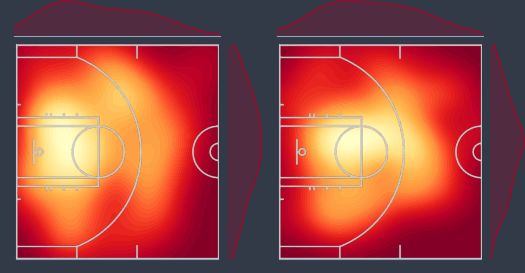
The individual distributions differ, but I would refrain from making judgments about individual players based on this data. With more tracking data, it would be interesting to see how players and teams change over time or to run a clustering algorithm on this data combined with shot-chart data.
Conclusion
League-wide, the distributions of assists leading to made and missed shots are quite similar. There is also variation between assist heat maps for different NBA positions, with guards generally passing from farther away and more often from behind the three-point line than forwards and centers.
Another topic that interests me is defensive positioning on made, missed, assisted, and unassisted shots by shot location.
The assists are available as CSV files in the mapped-assists repository.
Acknowledgments
Thanks to Dean Oliver, Todd Whitehead, and Patrick McFarlane for their feedback on this project. A lot of this post was based on their suggestions. I found the example plays using 3ball.